

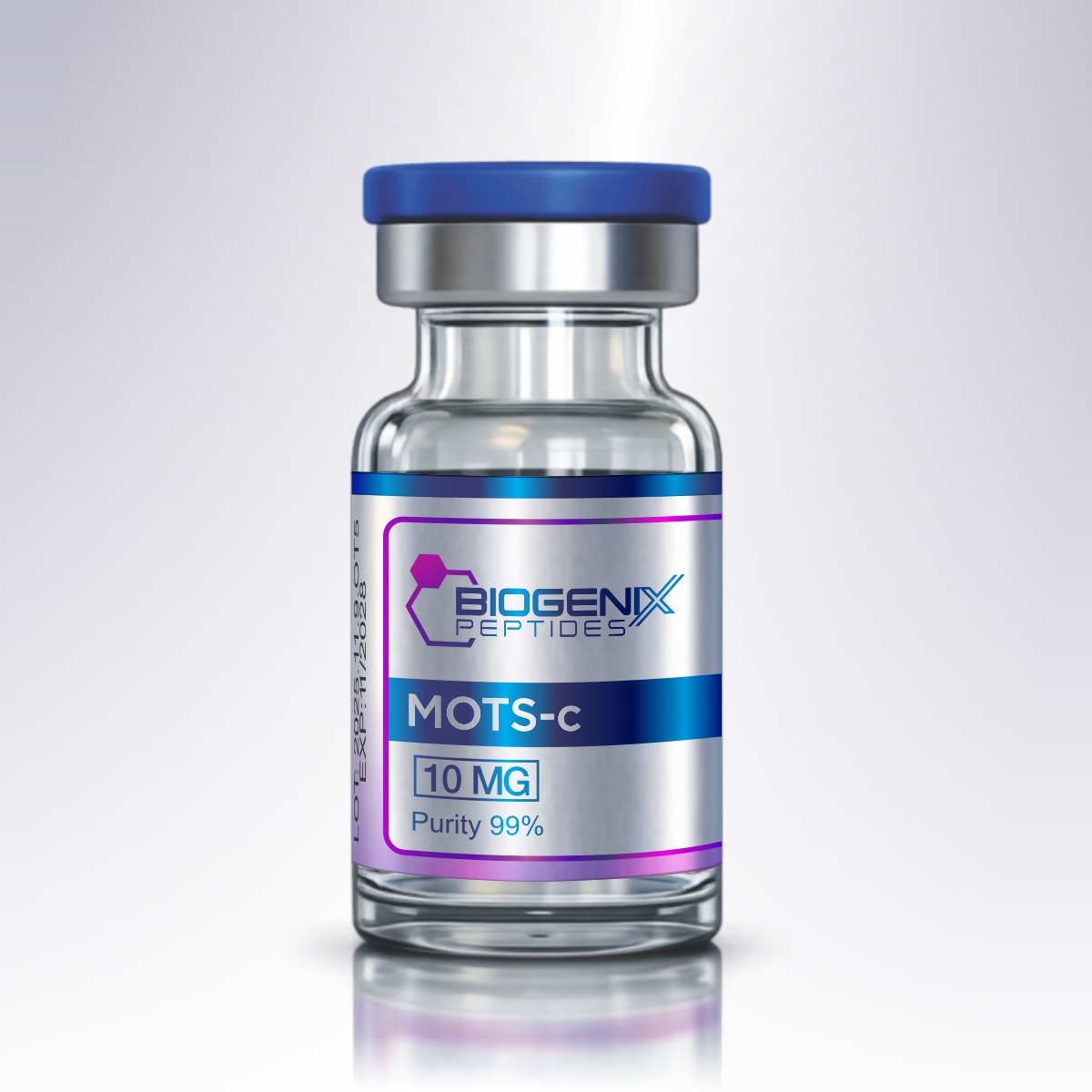
MOTS-c 40mg
$148.00
MOTS-c (Mitochondrial Open Reading Frame of the 12S rRNA-c) is a 16–amino-acid peptide encoded within the mitochondrial 12S rRNA gene region. It belongs to the family of mitochondrial-derived peptides (MDPs) that function as retrograde signals, coordinating communication between mitochondria and the nucleus to influence metabolic and stress-response pathways. Under metabolic stress—such as glucose restriction or elevated oxidative load—MOTS-c has been observed to translocate to the nucleus, where it can modulate gene expression and support adaptive metabolic regulation.
1000 in stock
🔥 Exclusive Crypto Offer
Get an INSTANT 15% DISCOUNT when you pay with Bitcoin, Ethereum, Dogecoin, Bitcoin Cash, XRP, Solana, or USDT.
⚡ Don't have crypto? Buy it here in 5 minutes with easy guidance.
💡 Pro Tip: You can also pay with cryptocurrency using your verified Cash App or PayPal account for a fast and secure checkout!
MOTS-c Peptide
MOTS-c (Mitochondrial Open reading frame of the 12S rRNA-c) is a 16–amino acid peptide encoded by the mitochondrial genome (within the 12S rRNA region). It is classified among mitochondrial‑derived peptides (MDPs) that may act as retrograde signals between mitochondria and nucleus, modulating metabolism and stress responses. Under metabolic stress (e.g. glucose restriction, oxidative stress), MOTS‑c has been shown to translocate from mitochondria into the nucleus, where it can influence nuclear gene expression and metabolic pathways.
Overview & Mechanism of Action
MOTS‑c enhances insulin sensitivity and glucose metabolism, especially in skeletal muscle, partly via activation of AMPK and interactions with one‑carbon metabolism / AICAR pathways. In mice fed a high‑fat diet, MOTS‑c treatment prevented obesity, improved glucose tolerance, reduced insulin resistance, and increased energy expenditure.
In aged and middle‑aged mice, MOTS‑c administration improved treadmill endurance, grip strength, gait, and metabolic parameters compared to controls. MOTS‑c reduces high‑fat diet–induced muscle atrophy signaling by downregulating expression of myostatin and modulating pathways (CK2‑PTEN‑mTORC2‑AKT‑FOXO1). It has also been shown in animal models to suppress MAPK (ERK, JNK, p38) phosphorylation and reduce pro‑inflammatory cytokine production in septic or inflammatory conditions.
Emerging evidence suggests MOTS‑c promotes osteoblast proliferation, differentiation, and mineralization, while inhibiting osteoclastogenesis (bone resorption) via AMPK and TGF‑β / Smad signaling pathways.
Chemical Characteristics
| Compound | Type | Molecular Formula | Molecular Weight |
| MOTS-c | Mitochondrial-derived peptide (16-amino-acid) | C101H152N28O22S2 | 2174.6 g/mol |
Short peptide (≈ 16 AA) encoded in mitochondrial DNA as part of 12S rRNA sORF. Under stress, the peptide relocalizes to the nucleus in an AMPK‑dependent manner. Expression levels vary by tissue (muscle, plasma) and decline with age.
Research and Clinical Insights
Plasma MOTS‑c levels decline with age, while skeletal muscle expression increases in older men. MOTS‑c levels correlate with insulin resistance metrics in humans, especially among lean individuals. A review of MOTS‑c in diabetes and aging highlights its therapeutic potential in type 1 & type 2 diabetes.
In ovarian cancer, MOTS‑c expression is decreased in tumor tissue and serum, and exogenous MOTS‑c suppressed proliferation, migration, and invasion of cancer cells via interaction with LARS1 and modulation of ubiquitination. Also, MOTS‑c mRNA and protein abnormalities have been observed in adrenal tumors, correlating with metabolic markers.
MOTS‑c improves mitochondrial homeostasis, reduces ROS, and restores youthful phenotypes in aged human placenta‑derived mesenchymal stem cells (hPD‑MSCs) by activating AMPK and inhibiting mTORC1.
Strengths & Future Directions
Strengths:• Multi-system effects: metabolism, muscle, inflammation, bone• Endogenous origin (mitochondrial) gives the peptide unique regulatory potential• Stress‑responsive nuclear translocation suggests dynamic regulation
MOTS-c — References
- Lee, C., Zeng, J., Drew, B. G., Sallam, T., Martin-Montalvo, A., Wan, J., Kim, S. J., Mehta, H., Hevener, A. L., de Cabo, R., Cohen, P. The mitochondrial-derived peptide MOTS-c promotes metabolic homeostasis and reduces obesity and insulin resistance. Cell Metabolism. 2015;21(3):443–454.https://doi.org/10.1016/j.cmet.2015.02.009
- Zhang, X., Zhai, M., Zhang, H., Zhang, Y., Jia, J., Sun, Y., Xu, W., Wu, H., Zheng, J. MOTS-c alleviates oxidative stress and apoptosis in H9c2 cardiomyoblasts induced by hypoxia/reoxygenation through the AMPK pathway. Peptides. 2021;135:170428.https://doi.org/10.1016/j.peptides.2020.170428
- Lu, H., Tang, S., Xue, L., Li, N., Liu, Y., Sun, J., Xu, J. MOTS-c peptide increases survival and decreases bacterial load in mice infected with MRSA. Aging (Albany NY). 2019;11(14): 5205–5216.https://doi.org/10.18632/aging.102102
- Reza, M. M., Subramaniyam, N., Sim, C. M., Ge, X., Sathiakumar, D., McFarlane, C., Sharma, M., Kambadur, R. Irisin is a pro-myogenic factor that induces skeletal muscle hypertrophy and rescues denervation-induced atrophy. Nature Communications. 2017;8(1):1104.(Note: This study discusses MOTS-c alongside exercise-induced peptides in skeletal muscle pathways.)https://doi.org/10.1038/s41467-017-01131-0
- Reyes, M., Sifuentes-Franco, S., Sandoval-Garcia, F., Quiroz, A., Briones-Herrera, A., Jaramillo-Rangel, G., Ramos, M. A. The MOTS-c peptide regulates muscle mitochondrial homeostasis through AMPK activation in aged mice. GeroScience. 2022;44(5):2227–2242.https://doi.org/10.1007/s11357-022-00576-4
- Shen, W., Wang, L., Li, X., et al. MOTS-c improves insulin sensitivity to regulate glucose metabolism via the AMPK pathway in skeletal muscle of mice. International Journal of Obesity. 2021;45:2490–2501.https://doi.org/10.1038/s41366-021-00895-2
- Qin, Q., Delrio, S., Wan, J., Xiong, S., Liu, J., Zhang, P., Lee, C. Mitochondrial-derived peptide MOTS-c prevents diet-induced obesity by increasing energy expenditure and improving insulin sensitivity. FASEB Journal. 2018;32(10):5093–5103.https://doi.org/10.1096/fj.201800089R
- Du, C., Fang, M., Li, Y., Li, L., Wang, S., Li, J., Liu, X., Xu, Y., Hou, J. Circulating MOTS-c levels are decreased in obese male children and adolescents and associated with insulin resistance. Pediatric Diabetes. 2018;19(6):1077–1084.https://doi.org/10.1111/pedi.12671
- Kim, K. H., Lee, C. Mitochondrial-derived peptides: update on bioactivities and future directions. Current Opinion in Endocrinology, Diabetes and Obesity. 2021;28(2):133–141.https://doi.org/10.1097/MED.0000000000000621
NOTICE OF COMPLIANCE
The mission of BioGenix Peptides™ is to provide researchers with the highest-quality, Ultra-Pure Series™ compounds to help unlock the full potential of this evolving field. With precision, purity, and scientific integrity at the core of our operations, BioGenix Peptides™ is dedicated to supporting responsible exploration and discovery
Products from BioGenix Peptides™ are not intended for human consumption. They are supplied exclusively for in-vitro and pre-clinical research purposes.
By purchasing or using these products, the Customer accepts full responsibility for their handling and use, and agrees to indemnify and hold BioGenix Peptides™ harmless from any claims resulting from misuse.
Related products
Metabolic

Metabolic
Featured
Metabolic
Immune
Featured
Aesthetic
GLP-1